
No products in the cart.
Return To ShopThe A-Z Maize Handbook: Expert Techniques and Proven Practices for Cultivating Maize Successfully
The A-Z Maize Handbook
The-a-z-maize-handbook . Maize cultivation is a crucial aspect of global agriculture, contributing significantly to food and industrial production. Maize, also known as corn, is a versatile cereal crop with a wide range of uses, including food, animal feed, and industrial products. Cultivated in diverse climates, maize adapts well to various soil types and is a staple in many diets worldwide.
Local Names. Yor. Agbada; Ibo Oka; Hausa Masara. General. A widely grown crop south of the Niger and Benue rivers, some are grown as far north as Zaria. Much is harvested as green cobs in the early crop. maize seed requires rich soil and 20-30 ins. of rain in the growing season. Varieties. Local varieties are recognized by color, carliness height of growth, and yield. The Departments of Agriculture are working on new introductions and resistance to maize rust. Varieties are usually grouped according to the characteristics of endosperm in the grain.
The following are the main types of maize: Flint Maize (var. indurata). The grain has hard cor- neous endosperm and there is no shrinkage.
The A-Z Maize Handbook The-a-z-maize-handbook . Maize cultivation is a crucial aspect of global agriculture, contributing significantly to food and…
Dent Maize (var. indentata). The grains have an indentation at the distal end caused by the shrinkage of starchy endosperm under the corneous layer.
Flour Maize (var. amylaceae). The endosperm is all starchy.
Sweet Corn (var. saccharata). The endosperm contains a lot of sugar. Dry grain is wrinkled and translucent. In the more southern areas the more easily ground white, soft-grain, varieties are most popular for local consumption. “Lagos White” is popular but not high-yielding. Tsolo, a hard yellow maize yields well. Trinidad Bulk, ESI ES2, and Mexico 5 are high-yielding imported and developed varieties but they have not achieved popularity despite disease resistance.
The harder yellow flinty types are grown to some extent in the savannah areas.
Much depends on the type of dish which is prepared locally from the maize.
Dishes made from dry-milled maize are more common in Western than Eastern Nigeria.
PLANTING
Seed is sown 1-14 ins, deep. In the south in March April for the early crop and early September for the late crop. In the north June is usual.
SPACING
Is spaced at 5 sq. ft. per stand or much wider than native farms when interplanted through yams or rice. on
SEED RATE
Sow 20-25 lbs. per acre for a sole crop. 2 or 3 seeds are sown per stand. The plants will later be thinned to one or two per stand.
GERMINATION
45 days are required for germination.
TASSELLING
Male inflorescences appear in 7-8 weeks.
MATURATION AND HERVEST
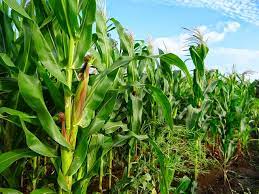
12-14 weeks (green) or 15-17 weeks (dry) are required for maturation, the early crop in June- August and the late crop in December-January.
YIELDS
The early crop gives 1,200-2,000 lbs. grain per acre and the late crop, 650-1,000 lbs. per acre (south).
The proportions of dry clean grains to cob weight are 65-75 percent for early maize and 70-80 percent for late maize.
LABOUR
45-50 man-days per acre are required for labor but up to 75 if a green manure crop is grown.
FIGURES
Number of grains per lb.-1,200-1,400; 273 heaped cigarette tins (50)-1 cwt.; I heaped cigarette tin (50)- 6-5 ozs.
DISEASES AND PESTS
Smut (Ustilago zeae). A fungus attacks the aerial parts, leaves stems and tassels, forming tubers of black spores. Control is to uproot and burn infected plants. Infected material should not be put into compost or fed to livestock. Generally, only isolated plants are affected so the disease is not serious.
Rust (Puccinia polysora). This fungus causes spotting and death of the leaves. The spots are reddish to purple and can be very serious in some years, particularly on the later-planted early crop. Some varieties show resistance, otherwise, control is not possible at present. Work on resistant varieties is proceeding.
Leaf Spot (Physoderma spp.). A fungus-causing spot. ting, usually of the lower leaves. Is generally not serious and control is by crop rotation.
Streak. A virus disease causes yellowish streaking of the leaves and deformation and stunting of the plant as a whole. The insect vector is thought to be a Cicadulina spp. The only control is to uproot and burn infected plants.
Stripe and Mosaic. These are virus diseases believed not present in Nigeria but suspected vectors of stripe are known to be present.
Army Worms. These may be very serious on young maize in some seasons. Control can be obtained by spraying with a lead arsenate mixture, 5. lbs. lead arsenate paste to 100 gals. water and add 5 lbs. soft soap as a spreader.
Stem Borers. Though generally not very serious in early maize, in late maize 20 percent of the crop may be lost. Destroy infected material and practice crop rotation to obtain control. Dusting with B.H.C. or D.D.T. on young plants up to 2 ft. high may give some control. D.D.T. 10 lbs. acre of 10 percent dust.
Weevils. Weevils are always troublesome in store and may be troublesome in the field with some varieties with open-ended cobs. Seed may be stored on the cobs in a smoky atmosphere (native practice) but is better stored in cribs or rumpus with the sheaths removed and dusted with 0-5 percent Lindane dust as the layers are put in. Shelled maize may also be dusted in the same way, with 4 oz. dust per 200 lb. grain. Bags in stacks may also be dusted but fumigation is better. In bulk storage, clean and fumigate stores before use and the grain before putting them into the e. Fumigation of shelled grain in larger quantities is done under gas-proof sheets using Methyl Bromide. 12 to 2 lb. of Methyl Bromide per 1,000 cu. ft. of stack and leave for 48 hours.
Fumigation of this sort should only be done under expert supervision.
Fumigation of small amounts of seed grain may be accomplished with carbon disulphide at ½ lb. per ton for 24 hours re- peated a few days later. A mixture of 3 parts ethylene dichloride and 1 part carbon tetrachloride at a rate of 6 pints of the fumigant per ton of grain for 48 hours is safer to use than Methyl chloride for small bag stacks.
Q1: What are the main types of maize varieties mentioned in the text? A1: The main types of maize varieties mentioned are Flint Maize, Dent Maize, Flour Maize, and Sweet Corn.
Q2: When is seed sown for the early and late crop in the south, and what is the usual sowing time in the north? A2: Seed for the early crop in the south is sown in March-April, while for the late crop, it’s sown in early September. In the north, June is the usual sowing time.
Q3: What is the recommended seed rate for a sole crop, and how many seeds are typically sown per stand? A3: The recommended seed rate for a sole crop is 20-25 lbs. per acre. Typically, 2 or 3 seeds are sown per stand, which are later thinned to one or two per stand.
Q4: How long does it take for maize seeds to germinate? A4: Maize seeds take approximately 4-5 days to germinate.
Q5: What are the typical yields per acre for the early and late maize crops in the southern regions? A5: The early maize crop yields 1,200-2,000 lbs. of grain per acre, while the late maize crop yields 650-1,000 lbs. of grain per acre in the southern regions.
Leave a reply
You must be logged in to post a comment.