
Fall armyworm control in Nigeria works best when you catch the caterpillars early. Check your maize every week from emergence, and act when roughly 10–20% of young plants show fresh damage. Then spray an effective insecticide such as emamectin benzoate straight into the funnel (whorl) in the early morning or evening. Combine this with early planting, clean weeding and crop rotation, and switch between insecticide groups so the pest does not become resistant.
This 2026 guide shows how to identify fall armyworm, when it attacks, how to scout, cultural and chemical control, a table of insecticides available on Farmpays, a spray schedule by crop stage, safety tips and common mistakes.
What is fall armyworm and why is it so dangerous?
Fall armyworm (Spodoptera frugiperda) is a caterpillar pest that came to West Africa around 2016. It is now found in maize farms across almost every Nigerian state.
The adult moth flies at night over long distances, and each female lays hundreds of eggs. The caterpillars (larvae) eat maize leaves, the growing point and later the cobs. It also attacks sorghum, millet and rice.
How do you identify fall armyworm in your maize?
Signs on the caterpillar
- Inverted Y on the head: a pale upside-down “Y” mark on the front of the head of older larvae.
- Four dots in a square near the tail end: on the second-to-last body segment, four dark spots form a square.
- Colour and size: young larvae are small and greenish; older ones are brown to dark grey with stripes and can reach about 3–4 cm.
Signs on the plant
- Small “windowpane” patches on young leaves where tiny larvae scrape the leaf surface.
- Ragged, irregular holes in leaves that look torn, not neat.
- Wet, sawdust-like droppings (frass) inside the funnel and on upper leaves.
- Later, holes in the cob and frass on the silk.
When does fall armyworm attack maize in Nigeria?
Fall armyworm can attack at any time maize is in the field. Pressure is often high in the early rainy season, when the first maize plantings come up (around March–May in the south and May–June in the north).
Irrigated dry season maize is also at high risk, because moths gather on the few green fields.
Most damage happens at the whorl stage, from about 2 to 6 weeks after planting. This is when larvae hide deep in the funnel and eat the young leaves that will become the plant’s main leaves. Late plantings next to older maize usually get the worst attack.
How do you scout for fall armyworm?
Scouting means walking through your farm to count damaged plants. It tells you if you really need to spray.
- Start about one week after emergence and scout once a week until tasselling.
- Walk in a W pattern across the field so you sample all parts, not just the edges.
- Stop at 5 points along the W and check 4 plants in a row at each point. That is about 20 plants.
- For each plant, look into the funnel and on leaves for fresh damage: new holes, wet frass or live larvae.
- Count how many of the 20 plants have fresh damage and work out the percentage (for example, 3 plants out of 20 = 15%).
- Act if roughly 10–20% of young plants show fresh damage. This is a common guide, not a fixed law; act sooner on very young plants.
Old dry holes with no frass usually mean the larvae have left or died. Do not spray for old damage alone.
Cultural control: what can you do without chemicals?
- Plant early and at the same time: plant with the first steady rains, and try to plant at the same time as neighbours. Staggered planting gives moths a non-stop food supply.
- Weed well: grasses and weeds host the pest. Keep the farm clean, especially in the first 6 weeks.
- Rotate crops: follow maize with soybean, cowpea or groundnut instead of maize again.
- Destroy crop residues: after harvest, plough in or remove old maize stalks that may hide pupae and late larvae.
- Feed the crop: well-fed maize recovers better from leaf damage.
- Handpick on small plots: on backyard or small farms, pick larvae from the funnel and crush them, or drop them in soapy water.
- Traditional sand or ash: some farmers push a pinch of dry sand, wood ash or sawdust into the funnel. It can irritate and dry out small larvae, but it is only useful on small plots and light attacks.
Biological options
Ants, earwigs, spiders, birds and tiny parasitic wasps eat eggs and young larvae. Too much spraying kills these helpers. Neem (azadirachtin) products and biopesticides based on Bacillus thuringiensis (Bt) work best on small larvae and early attacks, and usually need repeat application.
Chemical control: which insecticides work on fall armyworm?
Emamectin benzoate is widely used by Nigerian maize farmers against fall armyworm. It works mainly through the stomach after larvae eat treated leaves and is effective at low doses.
Chlorantraniliprole and flubendiamide (the “diamide” group) are also strong on caterpillars. Lambda-cyhalothrin (a pyrethroid) kills on contact and works best on young larvae; it is weaker on big larvae hidden deep in the funnel.
Do not use chlorpyrifos. NAFDAC banned it in Nigeria from 1 November 2024. Paraquat and atrazine are also banned and must not be used.
Insecticides for fall armyworm on Farmpays
| Product | Active ingredient | How it works | Farmpays price |
|---|---|---|---|
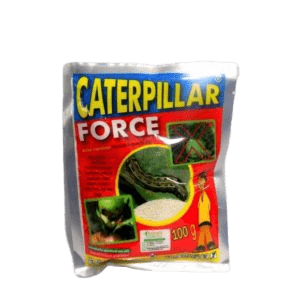
| Caterpillar Force 100g | Emamectin benzoate 5% WDG | Stomach action; stops larvae feeding within hours | Around ₦6,000 |
| DPRO 5.7 WG 100g | Emamectin benzoate 57 g/kg | Stomach action, same group as above | Around ₦2,600 |
| Eagrowell Insecticide SC | Emamectin benzoate + indoxacarb | Two groups in one; stomach and contact action | Around ₦1,200 |
| Hallakat Insecticide 250ml | Emamectin benzoate + acetamiprid | Emamectin for caterpillars; acetamiprid for sucking pests | Around ₦11,050 |
| Ampligo Insecticide | Chlorantraniliprole + lambda-cyhalothrin | Diamide (stomach) plus pyrethroid (fast contact knockdown) | Around ₦65,000 |
| Belt Expert 100ml | Flubendiamide + thiacloprid | Diamide group; stops larvae feeding | Around ₦13,000 |
| Karate 5 EC 250ml | Lambda-cyhalothrin 5% EC | Contact pyrethroid; best on young larvae | Around ₦5,200 |
| Neemsol GA 1L | Azadirachtin (neem) | Botanical; reduces feeding and growth of young larvae | Around ₦20,800 |
Prices change, so check each product page for today’s price. Always follow the label for the dose per 15–16 litre knapsack and the pre-harvest interval.
How to spray fall armyworm correctly
- Scout first and confirm fresh damage is above the action level.
- Read the label and measure the dose with a measuring cup or syringe, not by guess.
- Spray early in the morning (before about 10 am) or late evening (after about 4 pm), when larvae come out to feed and the sun will not break down the product quickly.
- Point the nozzle down into the funnel of each plant, not just over the leaves.
- Do not spray before heavy rain or in strong wind.
- Check again 3–5 days later. If many live larvae remain, the next spray should use a product from a different group.
Rotate insecticide groups to avoid resistance
If you spray the same active ingredient again and again, the surviving larvae breed and the pest becomes harder to kill. Rotate between groups, for example emamectin benzoate first, then a diamide product such as chlorantraniliprole or flubendiamide, then back. Changing brand name is not rotation if the active ingredient is the same.
Fall armyworm spray schedule by maize stage
| Crop stage (approx.) | Risk level | What to do |
|---|---|---|
| Emergence to 2 weeks | Moderate | Scout weekly. Handpick on small plots. Spray only if fresh damage passes the action level. |
| 2–6 weeks (whorl stage) | Highest | Scout weekly. First spray with emamectin benzoate into the funnel if needed. Second spray 7–14 days later only if damage continues, using a different group. |
| 6–8 weeks (late whorl to tasselling) | Moderate | Keep scouting. Larvae may move into the tassel. Spray only if many live larvae are found. |
| Silking and cob formation | Moderate to high for cobs | Check silks and cob tips. Spray targeted to the ear zone only if larvae are entering cobs. |
| Grain filling to harvest | Low | Usually no spray. Respect the pre-harvest interval on the label. |
Safety: protect yourself when spraying
- Wear gloves, rain boots, long sleeves and trousers, a face mask and eye protection.
- Do not eat, drink or smoke while spraying, and wash your body and clothes afterwards.
- Store chemicals locked away from children, food and animals. Never reuse empty containers for water or food.
Common mistakes Nigerian farmers make
- Spraying in hot afternoon sun, when larvae are hiding and the chemical breaks down quickly.
- Spraying over the top of leaves instead of into the funnel.
- Waiting until the plants are badly ragged before acting.
- Using the same active ingredient all season.
- Buying fake or unlabelled chemicals from unknown sellers.
- Still using banned products like chlorpyrifos.
Recommended products
- Caterpillar Force Insecticide 100g (Emamectin Benzoate 5% WDG) – emamectin for funnel sprays.
- DPRO 5.7 WG Insecticide 100g (Emamectin Benzoate 57 g/kg) – Biostadt – budget-friendly emamectin option.
- Eagrowell Insecticide SC (Emamectin Benzoate 1.5% + Indoxacarb 8.5%) – two groups in one.
- Ampligo Insecticide Sachet – diamide-based product to rotate with emamectin.
- Belt Expert Insecticide 100ml (Flubendiamide + Thiacloprid) – Bayer – another diamide option for rotation.
- Karate 5 EC Insecticide 250ml (Lambda-Cyhalothrin 5% EC) – contact spray for young larvae.
- Neemsol GA Botanical Insecticide 1L (Azadirachtin Neem) – Greenfields – botanical option for light attacks.
- Vision Knapsack Sprayer 16L (Manual) – Vision – for directing spray into the funnel.
- Black Work Hand Gloves for Farmers – protect your hands when mixing.
- Long Rain Boot (Yellow) Knee-High PVC Farm Boot – protects feet and legs.
- Urea Fertilizer 50kg – helps damaged maize recover.
Frequently asked questions
What is the best insecticide for fall armyworm in Nigeria?
Emamectin benzoate is widely used and works well when sprayed into the funnel early. Diamide products like chlorantraniliprole and flubendiamide are also effective. The best plan is to rotate between these groups and follow the label.
How many times should I spray maize for fall armyworm?
Many farms need one or two sprays during the whorl stage, but it depends on your scouting results. Spray only when fresh damage passes the action level. Do not spray on a fixed calendar without checking.
Does sand or ash in the funnel really work?
It can help on small plots with light attacks, because it irritates and dries small larvae. It is too slow and labour-heavy for large farms. Use it with scouting and handpicking, not as your only control.
Is chlorpyrifos still allowed for fall armyworm?
No. NAFDAC banned chlorpyrifos in Nigeria from 1 November 2024. Do not buy or use it, even if a seller offers it.
Can maize recover from fall armyworm damage?
Yes, maize can often recover from leaf damage if the growing point is not destroyed and the larvae are controlled early. Good fertilizer and weeding help. Damage to the growing point or cobs causes the biggest yield loss.
Get your fall armyworm control products from Farmpays
Do not wait until your maize funnels are eaten out. Order emamectin benzoate, diamide insecticides, knapsack sprayers and safety gear on farmpays.com, or WhatsApp us on 0810 845 2311 for help choosing the right product. We deliver nationwide from Ibadan.